Full Arch Dental Implants in London for Facial Support and Smile Balance
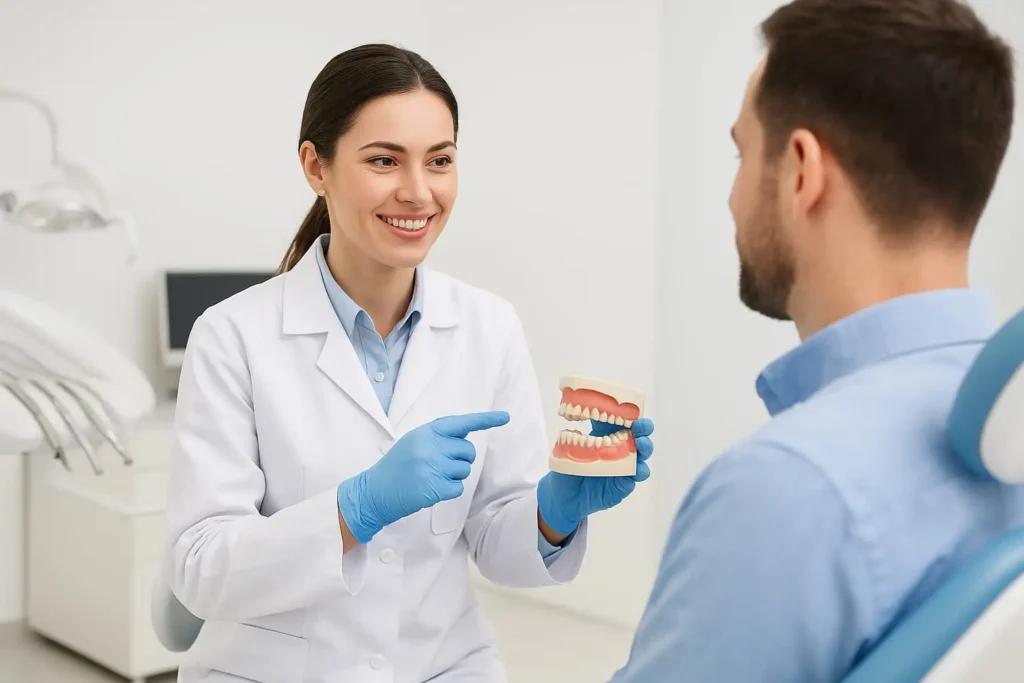
Losing several teeth can change more than the appearance of your smile. You may notice that your lips sit differently, your mouth appears slightly sunken, or the distance between your nose and chin seems shorter. These changes can develop gradually as the teeth and their supporting structures are lost.
Full arch dental implants can help restore facial support by replacing missing teeth with a stable bridge designed around your facial proportions, lip position and natural bite. However, the extent of improvement depends on your existing bone, soft tissues and the design of your replacement teeth.
If you are considering full arch dental implants in London, understanding how treatment influences facial appearance can help you develop realistic expectations beyond simply having fixed teeth again.
Why tooth loss changes your facial appearance?
Natural teeth contribute to the shape and support of the tissues surrounding the mouth. When several teeth are lost, changes can occur in both the jawbone and the lower part of the face.
Following tooth loss, the bone that previously surrounded the roots gradually reduces in volume. This natural process is known as bone resorption.
As dental support diminishes, you may notice:
- Lips appearing thinner or turning slightly inwards.
- A reduced distance between the nose and chin.
- More noticeable folds around the mouth.
- Changes in the appearance of the cheeks.
- Reduced tooth visibility when smiling.
These changes vary considerably between individuals. Ageing, genetics, skin elasticity and changes in facial fat also influence facial appearance.
Dental treatment can address changes associated with missing teeth and reduced dental support, but it cannot reverse every aspect of facial ageing.
How full arch dental implants restore facial support
A full arch implant restoration replaces an entire row of upper or lower teeth using a fixed bridge supported by dental implants positioned within the jawbone.
The appearance of the face is influenced not simply by the implants themselves, but by how the replacement teeth and artificial gum tissue are designed.
Restoring natural lip support
The position and angle of the front teeth influence how the lips rest and move during speech and smiling.
If replacement teeth are positioned too far inwards, the upper lip may appear insufficiently supported. Positioning them too far forwards can create an unnatural or excessively prominent appearance.
Careful planning helps establish a comfortable relationship between the teeth and lips, both at rest and during movement.
Where substantial bone and gum tissue have been lost, a bridge incorporating gum-coloured material may help replace some of the missing tissue volume.
Re-establishing a comfortable bite height
Extensive tooth loss or severe tooth wear can reduce the vertical dimension of the bite. This describes the relationship between the upper and lower jaws when the teeth meet.
Restoring an appropriate bite height may improve lower facial proportions and provide a more comfortable position for chewing and speaking.
However, increasing bite height excessively can cause discomfort and functional difficulties. The aim is to establish a balanced, comfortable bite rather than simply make the face look fuller.
Helping maintain supporting bone
Dental implants transfer chewing forces into the surrounding jawbone. This may help maintain bone around successfully integrated implants.
However, implants do not automatically replace bone that has already been lost or guarantee that further bone loss will never occur. Long-term bone health remains influenced by implant positioning, oral hygiene, inflammation and individual risk factors.
Creating a balanced smile that suits your face
A natural-looking smile involves considerably more than straight, white teeth. Replacement teeth should complement the patient’s facial features without appearing disproportionate or artificial.
During full arch treatment planning, a dentist considers the relationship between several features:
- Tooth visibility: How much of the upper teeth can be seen when the lips are relaxed.
- Smile line: How the teeth and gum tissue appear during a natural smile.
- Tooth proportions: The length, width and shape of the replacement teeth.
- Dental midline: How the centre of the teeth relates to the facial features.
- Speech: How the teeth interact with the lips and tongue during pronunciation.
Photographs, digital scans and trial restorations can help assess these relationships.
For patients considering full mouth dental implants in London, planning both arches together can be particularly helpful when extensive tooth loss has affected the entire bite. Replacing both arches is not necessary, however, when healthy teeth can be retained.
Are fixed implants always better than dentures for facial support?
Although fixed implant-supported bridges offer stability and do not need to be removed by the patient, they are not necessarily the best option for every facial support concern.
| Treatment | Facial support considerations |
|---|---|
| Conventional dentures | Can replace missing tissue volume and support the lips, although stability varies. |
| Implant-retained overdentures | Provide additional stability while allowing the denture to extend into areas requiring greater lip support. |
| Fixed full arch implants | Provide stable replacement teeth with individually planned tooth and gum contours. |
Patients with substantial upper jawbone loss may actually achieve more suitable lip support with a removable implant-retained overdenture.
This is because extending a fixed bridge too far towards the lips can create bulky contours that are difficult to clean.
The most appropriate restoration must balance appearance, comfort, stability and access for daily oral hygiene.
How dentists assess your suitability for full arch dental implants
Facial appearance alone cannot determine whether full arch implant treatment is suitable.
A clinical assessment considers the condition of any remaining teeth, gum health, available bone, jaw relationships and the amount of missing supporting tissue.
A three-dimensional cone beam CT (CBCT) scan, where clinically indicated, helps assess bone volume and identify important anatomical structures.
Medical history, smoking, diabetes, previous gum disease and teeth grinding may also influence treatment planning and long-term outcomes.
Where natural teeth remain, their potential for preservation should be assessed before considering extraction. Full arch treatment should not involve removing healthy, maintainable teeth solely to achieve a more uniform smile.
Are fixed implants always better than dentures for facial support?
Patients exploring Smile in a Day in London may be suitable for receiving a temporary fixed bridge on the day their implants are placed.
This can provide an early improvement in tooth appearance and dental support. However, same-day teeth depend on achieving sufficient initial implant stability and meeting other clinical requirements.
The temporary bridge also provides an opportunity to assess lip support, speech, tooth shape and bite comfort before producing the final restoration.
As the gums heal and swelling settles, the appearance around the mouth may change. Further adjustments may therefore be needed.
Same-day teeth should not be confused with completed implant treatment. The implants still require time to integrate with the bone.
Maintaining facial support and smile balance over time
Implant-supported teeth require ongoing care, even though the replacement teeth cannot develop tooth decay.
Inflammation around implants, known as peri-implant disease, can damage supporting tissues and potentially lead to bone loss. Bridges may also require adjustments or repairs because of wear, chipping or component loosening.
Daily cleaning underneath the bridge, regular professional maintenance and monitoring of the bite are essential parts of long-term implant care.
A well-designed restoration should therefore be as practical to maintain as it is aesthetically pleasing.
Conclusion
Full arch dental implants can help restore the dental support that contributes to natural lip position, comfortable bite function and balanced facial proportions. Their benefits depend on thoughtful restoration design rather than implant placement alone.
For patients considering full arch dental implants in London, an individual assessment with Fixed Teeth Solutions can help establish which restorative approach is appropriate, taking into account existing facial support, oral health and functional needs.
The goal should be a comfortable, maintainable smile that complements your natural facial features, without creating unrealistic expectations of facial rejuvenation.